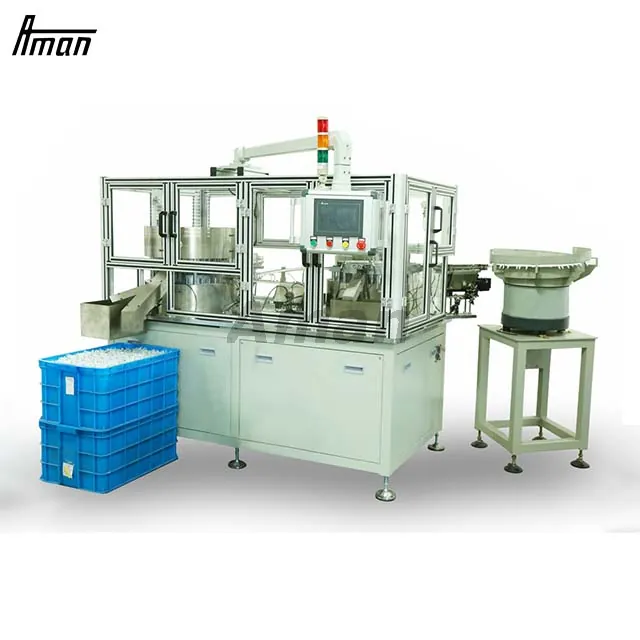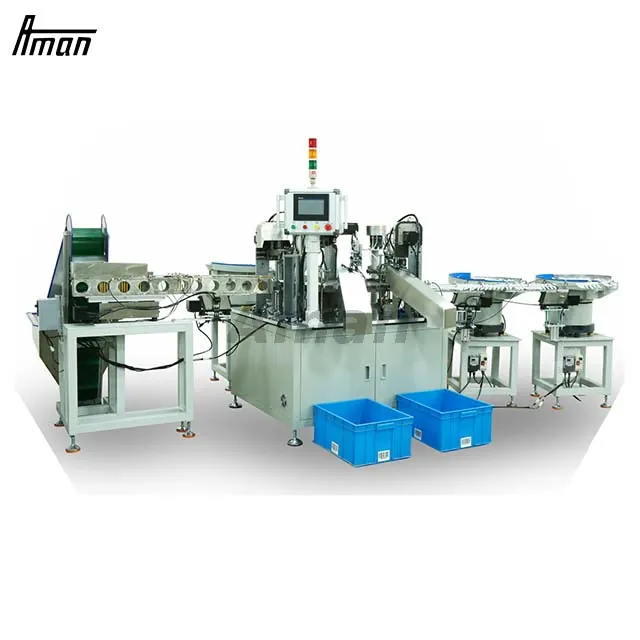
Aerosol Valve Assembly Machine
Footage: a rotary assembly machine of the same type, shown here putting fine mist sprayer pump parts together station by station. Your aerosol valve machine is set up for your own valve parts.
An assembly machine for aerosol valves. An aerosol valve is built from several small parts: typically a mounting cup, a gasket, a stem, a spring and a housing, often with a dip tube. A valve assembly machine feeds these parts and puts them together step by step, fitting the stem and spring into the housing, adding the gasket and crimping the mounting cup onto the housing.
Every machine is set up for the customer's own valve parts, so the steps and speed depend on your valve.
Send drawings or photos of each part and the assembled valve, and we'll tell you whether it can be assembled, and how fast.
Key Points
- Assembles aerosol valves
- Set up for your own valve parts
- Exact quote within 24–48 hours once we have your part details
- Warranty: 2 years on mechanical parts, 1 year on electrical parts, for faults not caused by misuse
Watch it run
 Watch the machine run
What happens at each station of an aerosol valve assembly machine?
An aerosol valve is built from five or six small parts, and each part and each key step gets its own station. The order below is one typical layout on a rotary machine; your valve may have a different part count or order, and the stations follow your parts.
| Station | What it does | What is checked |
|---|---|---|
| 1. Housing | A vibratory bowl lines up the housings and places one in each fixture | Housing present and the right way up |
| 2. Spring | The spring drops into the housing | Spring present |
| 3. Stem | The stem is pressed onto the spring and into the housing | Stem present and at the right height |
| 4. Stem gasket | The stem gasket is placed over the stem | Gasket present and seated flat |
| 5. Mounting cup | The cup is placed over the stem and housing (the cup gasket is usually fitted to the cup beforehand, or at its own station) | Cup present |
| 6. Crimp | The cup's pedestal is crimped over the housing so the valve stays together | Crimp checked; stem moves freely |
| 7. Dip tube (if fitted) | At an in-line station after the table, the tube is fed from a reel, cut to length and pushed onto the tail of the housing | Tube present |
| 8. Sort and discharge | Faulty valves go to a reject chute; good valves leave on the outfeed | Good and reject counts |
The stem gasket and the crimp decide whether the finished valve seals, so those two stations get the closest checks. Send drawings or photos of each part and the assembled valve, and we lay out the stations for your valve.
Rotary, in-line or semi-automatic: which layout fits your valve?
Three layouts are used for small dispensing parts like valves; the speed for your valve is set by its parts and your output.
| Layout | How the valve moves | When it fits |
|---|---|---|
| Rotary indexing machine | Each valve sits in its own fixture on a round table that indexes one station at a time | All the steps fit on one round table |
| In-line (linear) line | Parts travel on a chain conveyor through stations set one after another | The valve needs more stations than one table carries, for example dip-tube cutting and insertion, or counting into cartons |
| Semi-automatic machine | An operator loads some of the parts by hand and the machine presses, fits or crimps them | Lower volumes, trial runs, or valve designs that change often |
We have supplied assembly machines to Pakistan, Italy and Bangladesh.
Not sure which fits? Send your valve parts and target output, and we tell you which layout fits and the speed to expect. Get an exact quote within 24–48 hours. See also how a rotary assembly machine works and how to choose an automatic assembly machine.
Typical specifications
| Item | Value |
|---|---|
| Output | 40–60 valves/min, about 2,400–3,600 an hour (typical, standard rotary model) |
| Parts | Mounting cup, stem gasket, stem, spring and housing; dip tube optional |
| Valve type | Standard 1-inch (25.4 mm) aerosol valves, male or female stem; other sizes are set to your parts |
| Layout | Rotary indexing table; in-line stations where more steps are needed, such as dip-tube insertion |
| Feeding | Vibratory bowls and feed tracks for the small parts; dip tube fed from a reel and cut to length at an in-line station |
| Checks | Sensors check each part after it is placed; faulty valves are sorted out |
| Air supply | 0.4–0.6 MPa (typical) |
| Power supply | Configured for your local power supply |
| Warranty | 2 years on mechanical parts, 1 year on electrical parts (faults not caused by misuse) |
Typical figures. The configuration is set by your valve parts and output.
Suitable Parts
Aerosol valves.
Frequently Asked Questions
Request a Quote for This Machine
Send us your part drawing or photos. We check which machine can assemble it, then send you a quote.