How to Choose an Automatic Assembly Machine
How to choose an automatic assembly machine: stand-alone machine, combined machine or full line. Three questions decide it, and the part details a supplier needs to quote, with real machines we supply.
What is an automatic assembly machine? An automatic assembly machine puts a product together from its separate parts without hand work: the parts are fed in, carried from station to station, and one assembly step is done at each station. The machines we supply come as stand-alone machines, combined machines that also test or line, and full lines, each matched to your own parts and steps.
Key takeaways
- Two questions pick the type and a third sizes it: the number of parts and steps points to a stand-alone machine or a full line, testing or lining on the same machine points to a combined machine, and your target output sets the number of heads and stations rather than the type.
- A stand-alone machine is one machine on one table: our rotary lotion pump assembly machine runs 40–60 pumps per minute (standard model).
- A combined machine saves buying a second one: trigger sprayers and lotion pumps are assembled and tested on one machine, and caps are assembled and lined on one machine.
- A full line sends products around a closed loop through several stations: our standard lotion pump line runs 50–65 pumps per minute for the whole line and covers about 40 m².
- To quote, a supplier needs drawings or photos of every part and of the assembled product, your target output and what must be checked; for caps from a moulding machine, add cavity count and cycle time.
Three questions that decide the machine
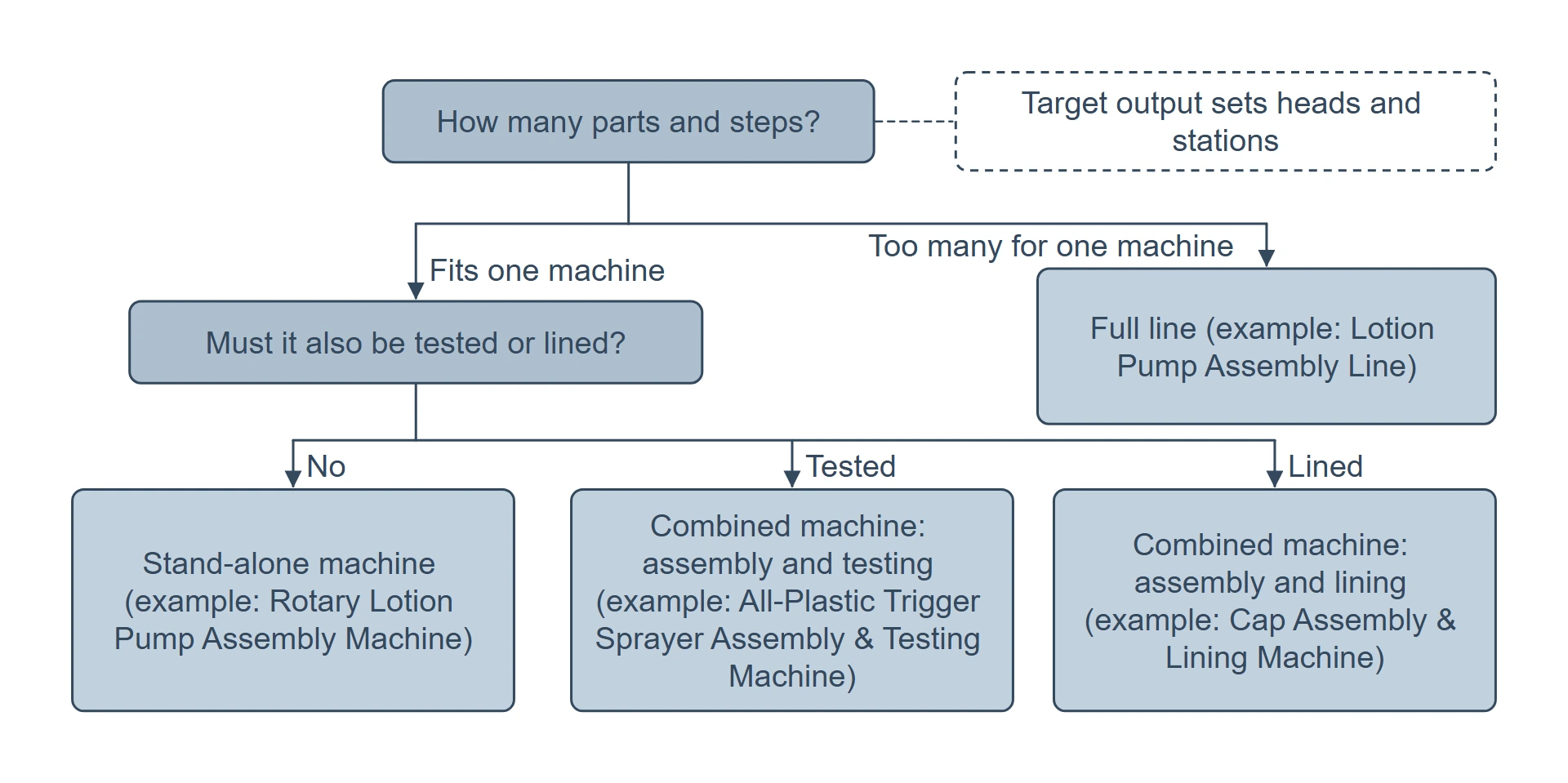
1. How many parts and steps? Each assembly step gets its own station, so the number of parts is the first thing a supplier asks. On a rotary machine a circular platform carries the parts from station to station with one assembly step at each station, and the stations are set up around your own parts and steps. That is why a three-part sprayer head, a five-part pump head and a six-part lotion pump are quoted separately. We supplied a three-part all-plastic trigger sprayer head machine to Pakistan rated at 4,000 heads per hour, a five-part pump head machine rated at 3,000 per hour, and a six-part lotion pump machine rated at 5,000 per hour. Rated speeds follow each customer's parts and are not a ranking.
2. How many per hour? Give a target output, because the speed is matched to your parts. Output sets the number of heads and stations rather than the type of machine. Standard figures show the range: a standard two-piece cap assembly machine runs 4,000–5,000 caps per hour depending on the cap, and a standard rotary lotion pump machine runs 40–60 pumps per minute. When a machine stands beside a moulding machine, the mould can set the speed: our flip-top cap closing machine handles up to 6,000 caps per hour, but on a shampoo cap line in Pakistan the customer's 8-cavity mould on a 20-second cycle sets it at about 1,440 caps per hour. Tell us your cavity count and cycle time.
3. Must the product also be tested, checked or lined? If it must, ask for a combined machine before you buy two. Our all-plastic trigger sprayer machine assembles and tests on the same machine, so you do not need a separate testing machine after assembly. Our cap assembly and lining machine assembles the cap and inserts the liner on one machine, replacing two. Tell us what each product has to be checked for, and we configure the stations for it.
An assembly and testing machine. What you will see: clear and pink sprayer parts moving through red-lit sensor stations on the all-plastic trigger sprayer assembly and testing machine.
A cap assembly and lining machine. What you will see: white parts running from a full vibratory bowl along feed tracks to the pick-and-place station.
Stand-alone machine, combined machine or full line?
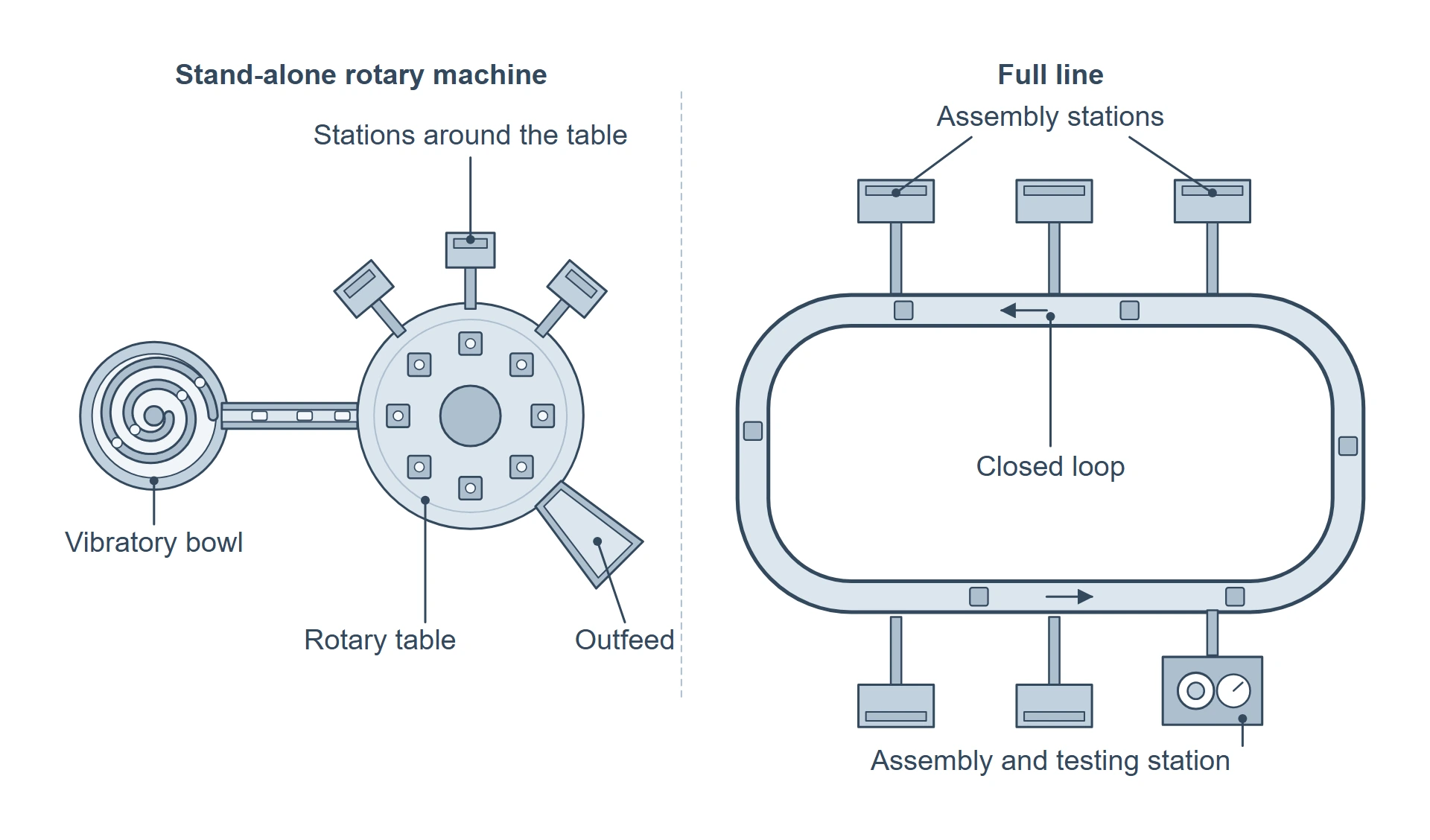
A full line is the answer when your product needs more stations than one machine carries. Our lotion pump machine page says so directly: need more stations, see the lotion pump line. On the line, pumps move around a closed loop and pass through the assembly stations one after another, and the final three-part assembly and testing station sets the pace.
| Choice | What it is | Example on our site | Standard figures |
|---|---|---|---|
| Stand-alone machine | One machine, one rotary table, parts come together station by station | Rotary Lotion Pump Assembly Machine | 40–60 pumps per minute |
| Combined machine: assembly and testing | Assembles and tests on the same machine | All-Plastic Trigger Sprayer Assembly & Testing Machine; Multi-Station Lotion Pump Assembly & Testing Machine | 50–90 per minute depending on the station; 50–65 per minute, 220 V, 1.2 kW, 3000 × 2800 × 1700 mm |
| Combined machine: assembly and lining | Assembles the cap and inserts the liner on one machine | Cap Assembly & Lining Machine | 5,000 caps per hour; 220 V, 2.5 kW, 2000 × 2000 × 1500 mm, 600 kg |
| Full line | Products move around a closed loop through the stations | Lotion Pump Assembly Line | 50–65 per minute for the whole line; 220 V, 4 kW, 0.6 MPa, about 3,000 kg, about 40 m² |
| Full line with inspection | A full line that ends with an inspection section | Trigger Sprayer Assembly Line with Inspection | 50–90 per minute depending on the station |
A full trigger sprayer line. What you will see: a trigger sprayer line with a rotary table, vibratory bowls and a red-lit inspection track.
Can it run in line with your injection moulding machine?
For caps, yes: parts can go straight from the moulding machine to assembly without manual handling. Our two-piece cap assembly machine can be set up in line with the injection moulding machine, and the standard model runs 4,000–5,000 caps per hour depending on the cap. Our flip-top cap closing machine can stand beside the moulding machine and close a full shot at a time: on a shampoo cap line we supplied in Pakistan it closes each shot of 8 caps in one go. For a cap line, the cavity count and cycle time matter as much as the cap drawing.
What is a special purpose machine?
A special purpose machine (SPM) is a machine designed for one specific job, such as assembling one particular product. Machines of this kind are built on a rotary assembly platform that we supply: a circular platform carries parts from station to station, with one assembly step at each station, laid out for your own parts and steps. See how a rotary assembly machine works.
What to send us
Send these five things and we tell you whether your product can be assembled, and how fast.
- Drawings or photos of each part.
- A drawing or photo of the assembled product.
- Your target output, per hour or per minute.
- What each product must be checked for, and whether it also needs testing or a liner.
- For caps from an injection moulding machine, your cavity count and cycle time; also your plant voltage and floor space.
Get an exact quote within 24–48 hours.