How a Vibratory Bowl Feeder Works, Step by Step
How a vibratory bowl turns a heap of loose small parts into a single, neat line that an assembly machine can pick up — the full sequence in plain language, with real assembly machines that run on it.
What is a vibratory bowl feeder? A vibratory bowl feeder is a bowl on a vibrating drive that sorts a heap of loose small parts, turns them all the same way round and delivers them one by one on a track to an assembly machine. Almost every automatic assembly machine we supply starts with one.
Key takeaways
- A vibratory bowl feeder works in five steps: load, vibrate up the track, sort and orient, leave on a feed track, hand over to the machine.
- The bowl does not "know" which way up a part is: the shape of the track does the sorting, with cut-outs, ledges, wiper blades and guards.
- A machine needs one bowl for each kind of part: two on a two-piece cap machine, four on our perfume pump and baby bottle cap machines.
- On larger machines an inclined elevator lifts loose parts into the bowl.
- Whether a part can be oriented depends on its shape and weight, so we ask for each part.
A lotion pump assembly machine — parts lifted into a vibratory bowl, fed along the tracks to the rotary table. What you will see: an inclined elevator lifting clear pump parts into a large vibratory bowl, the parts leaving on toothed tracks past a row of sensors, and the pumps coming together station by station on the rotary table.
The caps, pump parts, pen parts and small medical parts we assemble are tipped into a bowl, and the bowl delivers them to the machine one at a time and the right way up. If you are planning to assemble a small plastic part automatically, this is the first thing to understand.
The five steps of vibratory feeding
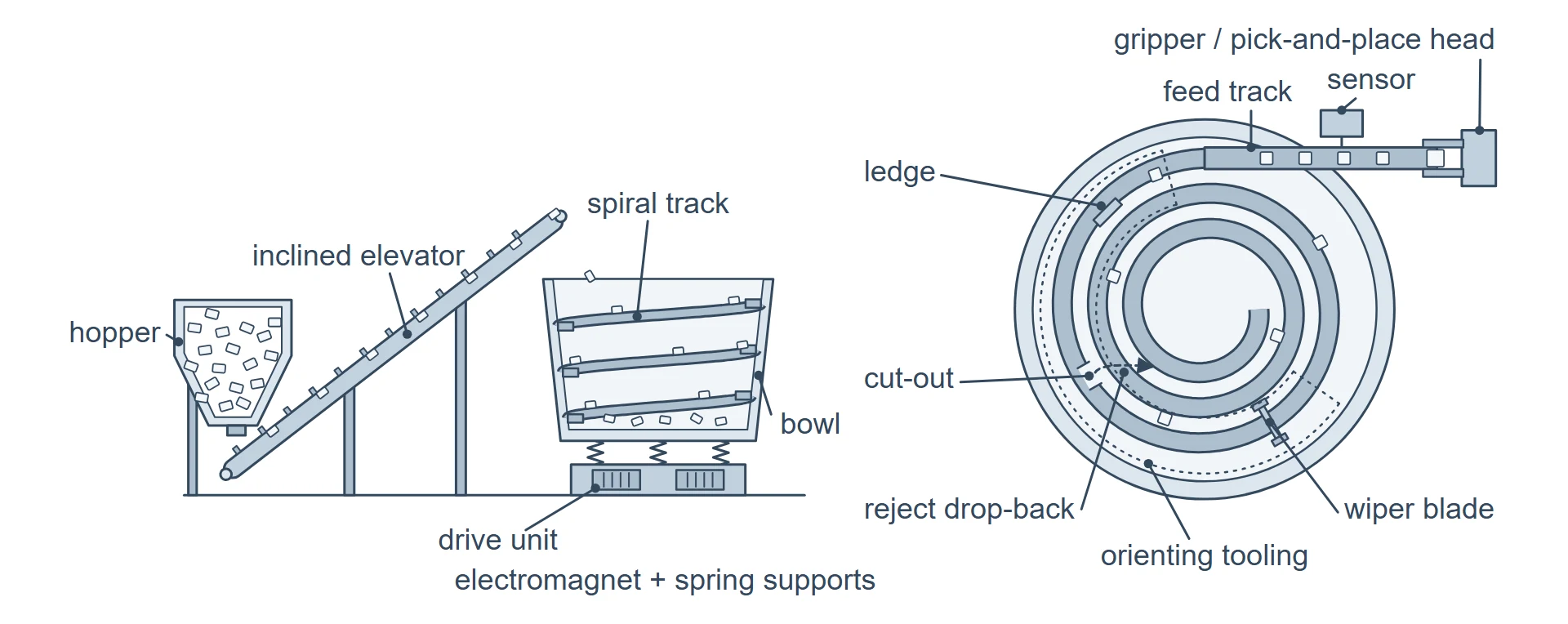
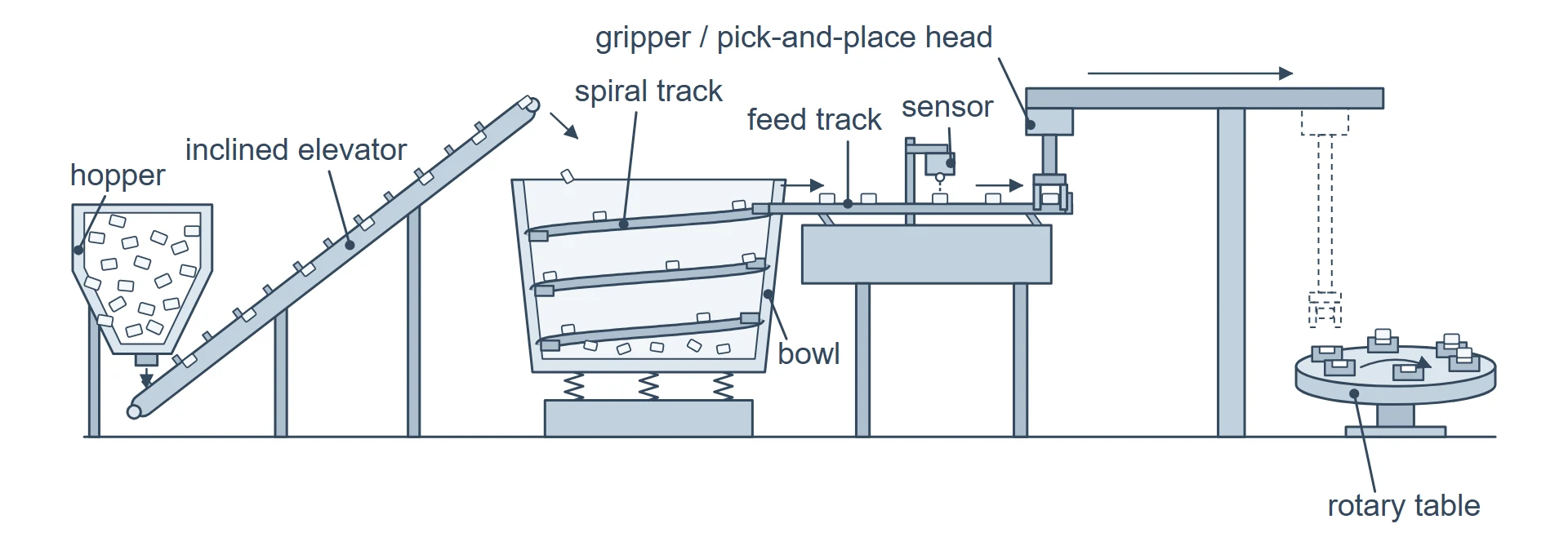
1. Load the parts into the bowl. An inclined elevator keeps the bowl supplied on larger machines. Loose parts are tipped into the bowl, where they form a heap at the bottom. On larger machines an inclined elevator lifts the parts from a hopper and tips them into the bowl, so the bowl stays supplied without anyone standing over it.
2. Vibrate the parts up the track. Small, angled vibrations make the parts hop up a spiral track. The bowl sits on a drive unit, usually an electromagnet working against a set of spring supports, that shakes it with small, fast, controlled vibrations; a controller sets how hard and how fast. The vibration is angled so that the parts hop forward in tiny steps along a spiral track that climbs the inside wall of the bowl.
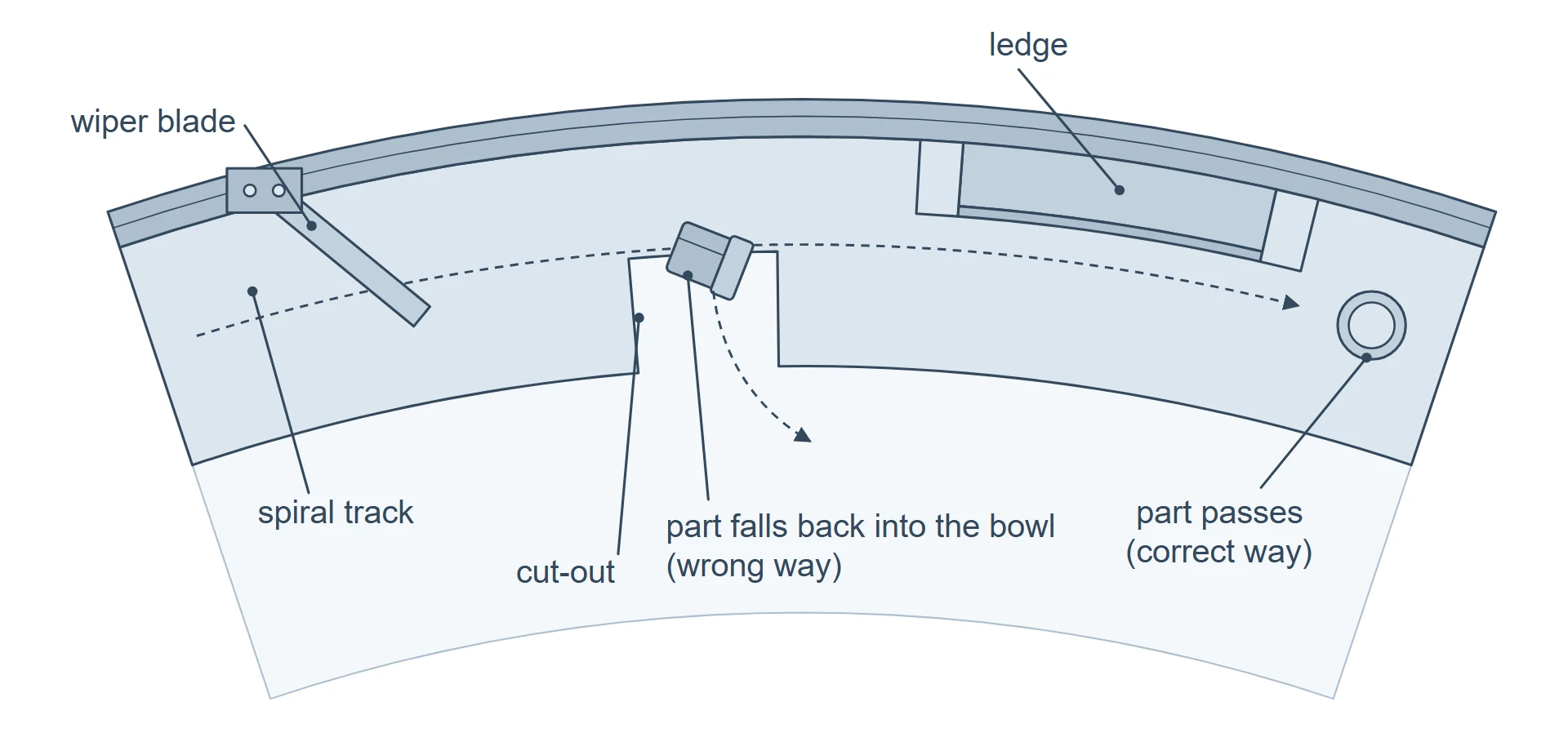
3. Sort and orient on the way up. Only parts lying the right way get past the track's shaped features. Shaped features along the track — cut-outs, ledges, wiper blades and guards — let a part pass only if it lies the right way. A part that is the wrong way round, on its side or stacked on another is knocked off the track and drops back into the bowl to try again. This is the step that gives the bowl its job: it turns a random heap into parts all facing the same direction.
4. Leave on a feed track in a single line. The parts leave the bowl one behind the other, watched by sensors. The oriented parts leave the bowl on a straight feed track, one behind the other. Sensors along the track watch the line, so the machine knows when parts are present. In our video you can see this: the parts leave the bowl on toothed tracks, past a row of sensors.
5. The machine takes one part at a time. A gripper lifts each part into a fixture, and a full track pauses the bowl. At the end of the track a gripper or a pick-and-place head (a head that picks a part up and places it) lifts the next part and sets it in a fixture — on a rotary table, in many of our machines. The bowl keeps feeding as parts are used. When the track is full, parts wait in line behind the last one, and a sensor on the track can pause the bowl until the machine has taken more.
One bowl per part
A machine that assembles several parts needs a bowl for each kind of part. Some examples from machines we have supplied:
| Machine | How the bowls are used |
|---|---|
| Two-piece cap assembly machine | Two vibratory bowls, each with its own storage hopper, sort and orient the two parts; the machine joins them and the finished caps are counted at the outlet |
| Baby bottle cap assembly machine | Four vibratory bowls on their own stands feed a glass-enclosed assembly section |
| Perfume pump assembly machine | Four vibratory bowls on their own stands feed a central, multi-level rotary table |
| Push-pull cap assembly machine, Indonesia | Two vibratory bowls sort the black cap parts and send them along feed tracks, past a row of red-lit sensors, to a rotary table where the two pieces are pressed together |
| Lotion pump assembly machine, Pakistan | An inclined elevator lifts the clear pump parts into a large vibratory bowl, which feeds them out along toothed tracks, lit by a row of sensors, to the rotary table; rated at 5,000 pumps per hour |
| Helmet knob assembly machine | A rotary indexing table with a spring bowl, and a spring coiler (a machine that forms the springs) in line beside it |
What can a bowl feed
On our machines the bowls feed a wide range of small parts: caps and cap parts, pump bodies and gaskets, dropper bulbs, mascara stems and brushes, pen parts, hinge pins, catheter connectors. Whether a particular part can be oriented depends on its shape and weight — which is why we ask for each of your parts when you enquire about a machine.