
How a Rotary Assembly Machine Works, Step by Step
How a rotary assembly machine builds a product on a turning table, one assembly step at each station — the full sequence in plain language, with real machines we have supplied.
What is a rotary assembly machine? A rotary assembly machine is a machine that assembles a product on a circular table. Each product sits in its own fixture, the table turns from station to station, and one assembly step is done at each station. Our rotary assembly platform is a high-speed circular platform that carries parts from station to station.
Key takeaways
- A rotary assembly machine works in five steps: feed the parts, set them in fixtures, assemble one step per station, check, and discharge the finished product.
- Each product stands in its own fixture on the table, and each station does one job: a gripper places a part, a press fits it, glue is dispensed and cured, or a sensor checks.
- The stations are set up around your own parts and steps, so the same platform serves as the base for custom assembly machines.
- Output depends on the part: for example, a three-part injection needle runs about 900–1,000 per hour, a seven-part wall switch about 1,200 per hour, and a two-piece disc-top cap machine we supplied is rated at 4,800 caps per hour.
- A chain conveyor is the other common layout; we use it, for example, on our insulin pen machines.
A rotary assembly platform. What you will see: a twin pick-and-place head loading parts from two feed tracks onto the turning table, with one assembly step done at each station.
The five steps of rotary assembly
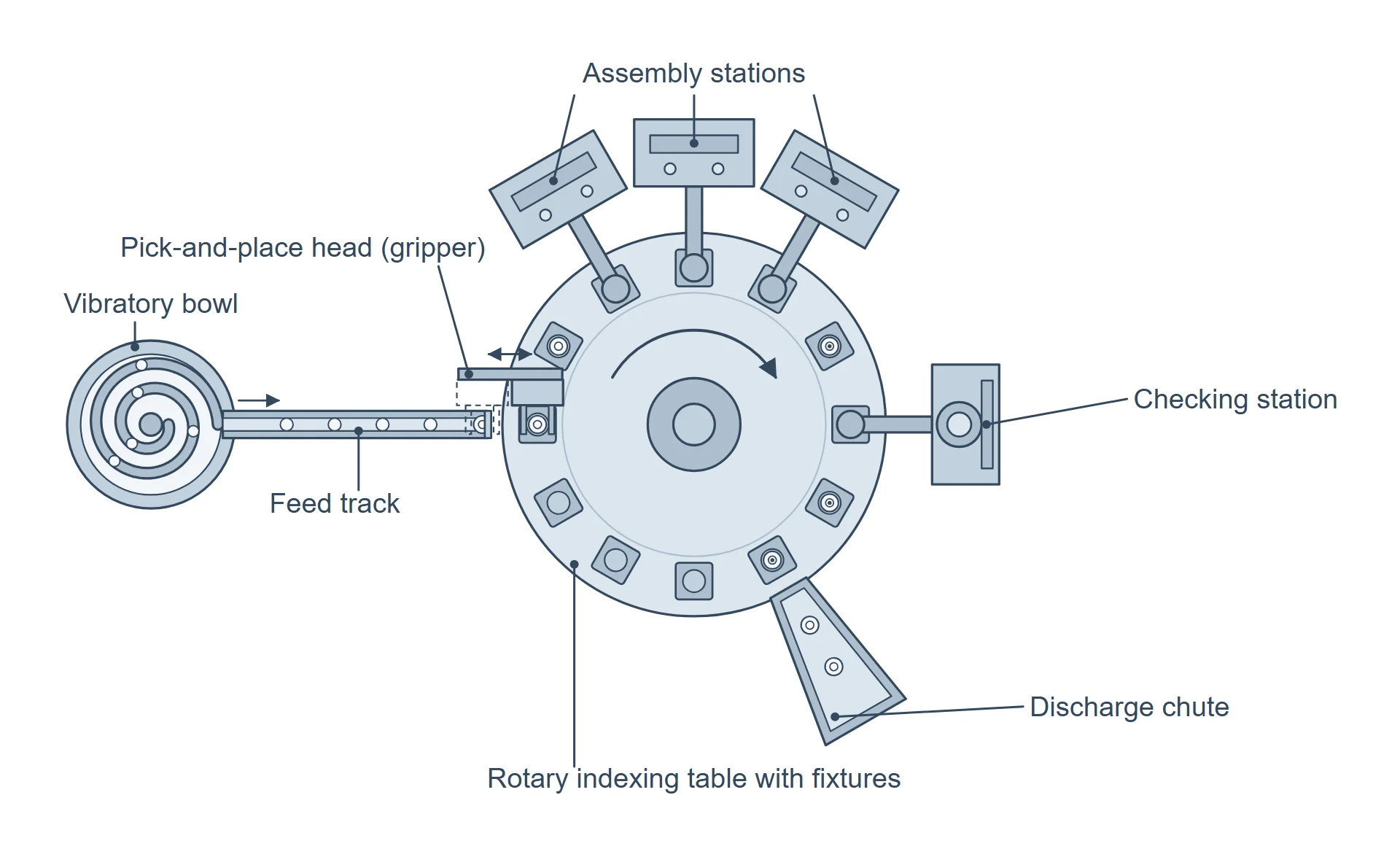
1. Feed the parts. Vibratory bowls and feed tracks bring each part to the table one at a time. Each kind of part has its own bowl and feed track, and a pick-and-place head loads the parts onto the table; on our rotary assembly platform a twin pick-and-place head loads parts from two feed tracks. See how a vibratory bowl feeder works.
2. Set each product in its own fixture. The fixture holds the product upright while it is built. On the disc-top cap machine we supplied to the UAE, each cap stands upright in its own round black holder on the table. On a pump core machine we supplied, each core stands upright in its own fixture.
3. Turn and assemble. The table moves the product from station to station, and each station does one step. Pneumatic grippers above the table pick up the next piece and set it in place as the table indexes: it turns one position, stops while every station does its step, then turns again. So every product is completed station by station. A pressing station can fit a part into its frame, as on our wall switch machine, and a needle machine dispenses glue where the cannula meets the hub and cures it under UV light.
4. Check. Sensors and fixtures check the product before it leaves. Rows of sensors sit along the feed tracks, and on our injection needle machine each finished needle is checked in a fixture.
5. Discharge. Finished products leave by a chute or an outfeed track and are counted. On the UAE machine, finished caps slide down a stainless steel chute straight into cartons; on our two-piece cap machine, finished caps are counted at the outlet.
Examples from machines we have supplied
| Machine | Parts | Layout | Output |
|---|---|---|---|
| Disc-top cap, UAE | Two-piece cap | Rotary table, one fixture per cap | 4,800 caps per hour (rated) |
| Lotion pump, Pakistan | Six-part pump | Rotary machine | 5,000 pumps per hour (rated) |
| Aerosol spray actuator, Pakistan | Five-part actuator | Rotary table | 4,200 actuators per hour (rated) |
| Pump core, UAE | Three small parts | Multi-station rotary table | 5,000 pump cores per hour (rated) |
| Wall switch | Seven parts | Rotary table with grippers and a pressing station | About 1,200 per hour (typical) |
| Injection needle | Three parts: hub, cannula, cap | Rotary table, glue dispensing and UV curing | About 900–1,000 per hour (typical) |
| Marker pen | Pen parts | Large rotary table past a ring of stations | 40–60 per minute, 2 per cycle |
| Helmet knob | Knob parts | Rotary indexing table | 10–15 per minute, one per cycle |
Rotary table or chain conveyor?
| Rotary table | Chain conveyor | |
|---|---|---|
| How products move | Round the table from station to station | Along a chain through a row of stations |
| Example on our site | Disc-top cap, lotion pump, aerosol actuator, pump core | Insulin pen barrel machine and pen assembly and testing machine, two pens per cycle |
| Where the stations sit | Around the table | In a row along the conveyor |