
Aman Machinery Get a quote
Home/Guides/Insulin Pen Assembly Line, Step by Step
Guide

Insulin Pen Assembly Line, Step by Step

Our insulin pen assembly line uses three standard machines: barrel assembly at 50–60 pieces a minute, assembly and testing at 50 pens a minute, and inspection with tray loading at 60 pens a minute. We have supplied them to Bangladesh.

Watch: insulin pen assembly, step by step

Video transcript

This video shows how an insulin pen is assembled by machine, from its parts to tested pens loaded into trays. The line has three machines: barrel assembly, assembly and testing, and camera inspection and tray loading. All three run on a chain conveyor, two pens at a time.

Step one: assemble the pen barrel. Pen barrels come from a hopper. They are screwed and pressed together. Then the spring and the cap go on. There is a check after each step, and faulty pieces are sorted out. The barrel assembly machine runs at fifty to sixty pieces per minute.

Step two: assemble the pen and test it. Vibratory bowls feed the parts, and a gripper head presses them into the pens on the chain. Then the machine tests each pen on the same chain. It checks torque in both directions, the length of the pen, and the dose window with its zero mark. Faulty pens are sorted out. The standard model runs fifty pens per minute. Tell us which checks your pen needs, and we set the stations around them.

Step three: inspect and load into trays. Cameras and sensors check each pen: the spring, the window, cracks, raised gate marks, and the zero mark in the window. Faulty pens are sorted out. A four-axis robot loads the good pens into trays, a row at a time. Empty trays are fed in, and full trays are taken out. The standard model runs sixty pens per minute, and the line is set up for your own tray.

Three steps: assemble the pen barrel, assemble the pen and test it, then inspect and load into trays. We have supplied these machines to Bangladesh. They are made by our long-term partner factories, and every machine is set up for your own pen parts. Send drawings or photos of your pen parts and your target output, and get an exact quote within 24–48 hours.

How is an insulin pen assembled by machine? Three machines do the job, each on a chain conveyor, two pens at a time. The barrel assembly machine screws and presses the barrels together and fits the spring and cap. The assembly and testing machine assembles the pen and checks torque, length and the dose window. On the inspection and tray loading line, cameras and sensors check each pen and a four-axis robot loads the good ones into trays.

What is insulin pen assembly? Insulin pen assembly is the process of putting an insulin pen together from its parts, testing it, and loading the good pens into trays. Our machines cover three steps: assembling the pen barrel, assembling and testing the pen on one machine, and final camera inspection with tray loading. We have supplied these machines to Bangladesh.

Key takeaways

  • The pen line has three machines: the barrel assembly machine, the assembly and testing machine, and the inspection and tray loading line.
  • All three standard models run on a chain conveyor, two pens at a time: 50–60 pieces per minute for the barrel, 50 pieces per minute for assembly and testing, and 60 pieces per minute for inspection and tray loading.
  • The assembly and testing machine checks torque in both directions, length, the dose window and its zero mark, and sorts out faulty pens.
  • Cameras and sensors check the spring, the window, cracks, raised gate marks and the zero mark; a four-axis robot loads the good pens into trays.
  • Every machine is set up for your own pen parts; send drawings or photos and your target output.

In one line: loose parts → barrel assembly → assembly and testing → camera inspection → good pens in trays.

The insulin pen assembly and testing machine. What you will see: test heads pressing on blue pens on the chain conveyor, and cameras and sensors checking the dose window and the zero mark.

The insulin pen assembly line in three steps
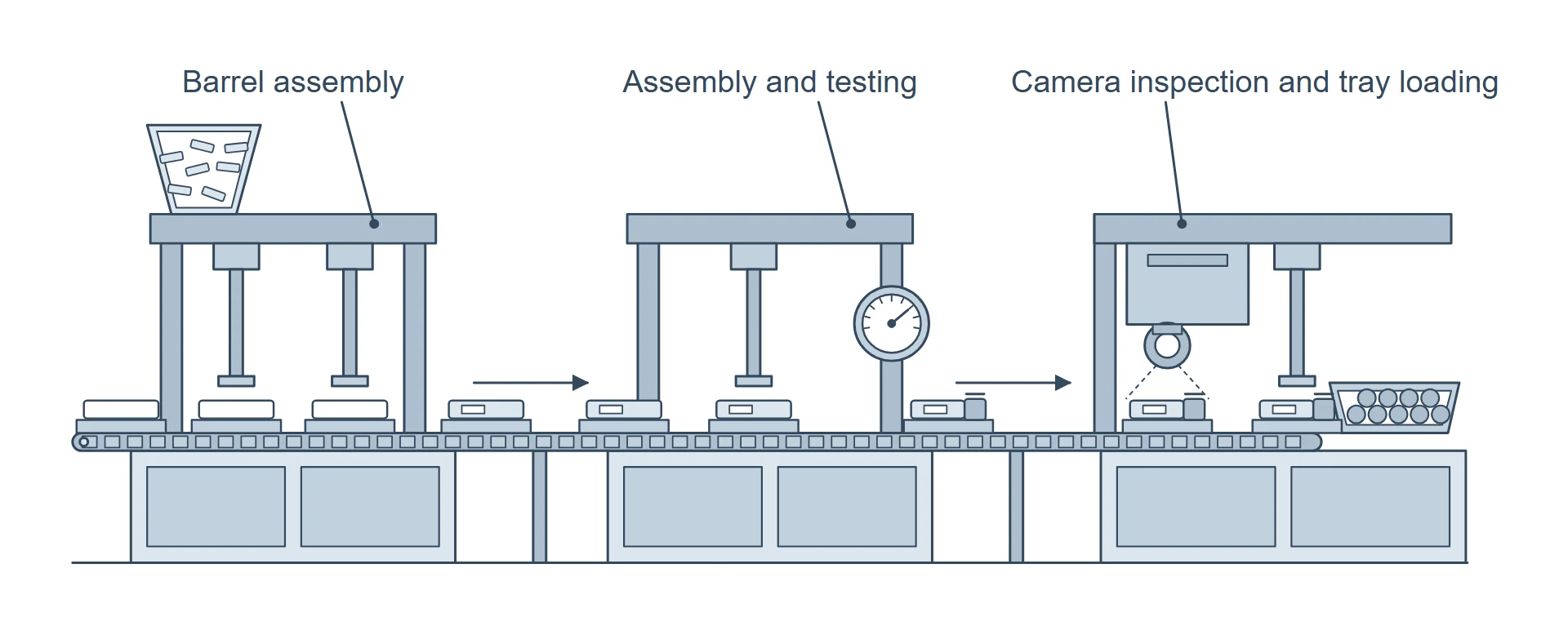
Insulin pen line in three steps: barrel assembly, assembly and testing, camera inspection and tray loading.
Figure 1. From parts to packed pens, three machines.

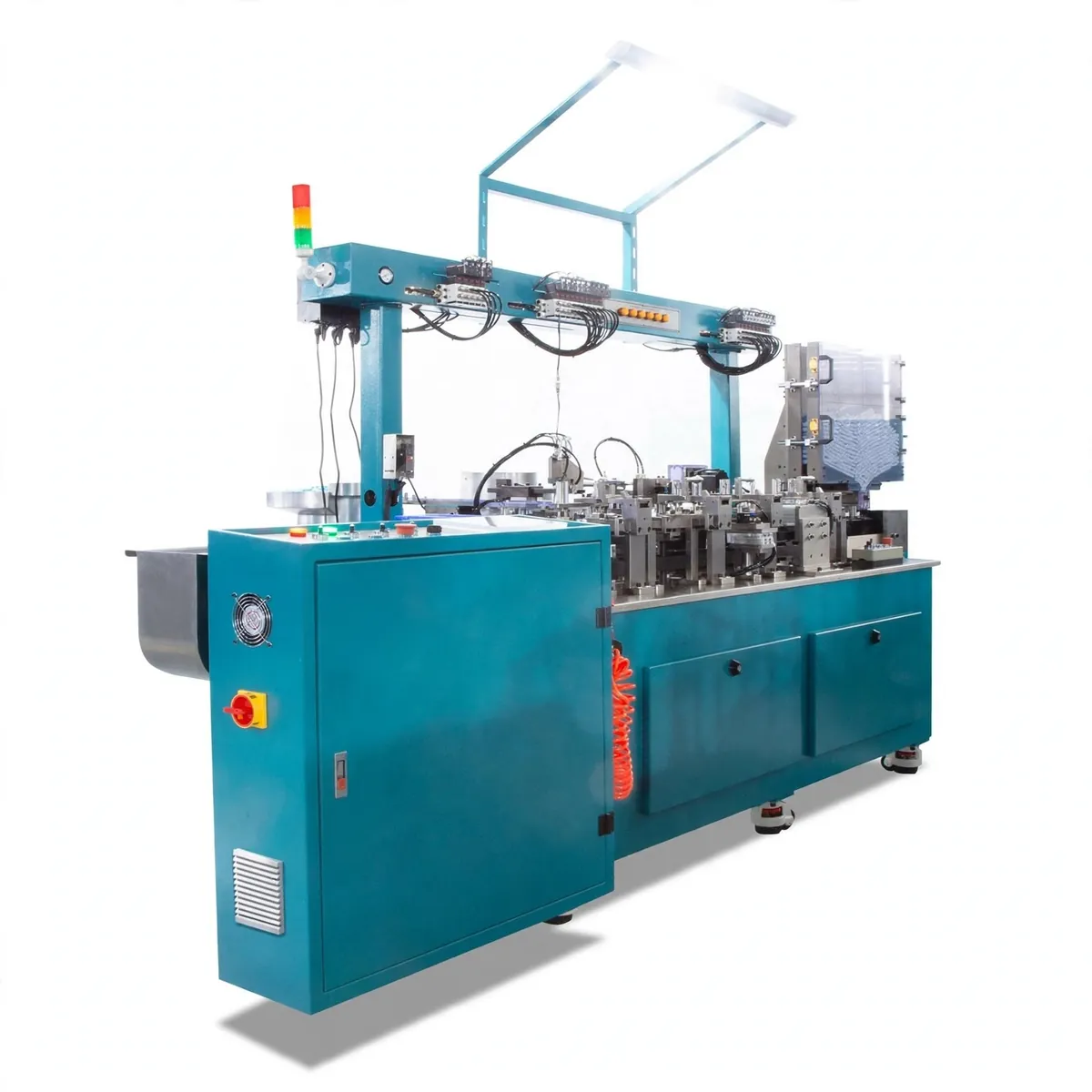
1. Assemble the pen barrel. Pen barrels come from a hopper, are screwed and pressed together, and then the spring and the cap go on. The insulin pen barrel assembly machine runs on a chain conveyor, two pens at a time, at 50–60 pieces per minute, with a check after each step and faulty pieces sorted out. The standard model measures 3100 × 1400 × 1800 mm. See the insulin pen barrel assembly machine page for the standard model, video and size.

The insulin pen barrel assembly machine. What you will see: pressing heads coming down on the pen barrels on the chain conveyor, a red sensor light checking the barrels, and a view from above of the pressing station.

Two pressing heads on the barrel assembly machine pressing down on blue pen barrels on the chain conveyor.
Step 1: two heads press on the pen barrels on the chain.
The insulin pen barrel assembly machine: a teal-blue frame with the assembly stations along the bench.
Step 1: the insulin pen barrel assembly machine.

2. Assemble the pen and test it. The machine assembles the pen, then tests torque in both directions, length, the dose window and its zero mark. A gripper head presses parts into the pens on the chain, vibratory bowls feed the parts, and faulty pens are sorted out. The standard model runs 50 pens per minute, two at a time, and measures 5400 × 1600 × 1800 mm. See the insulin pen assembly and testing machine page for the standard model, video and size.

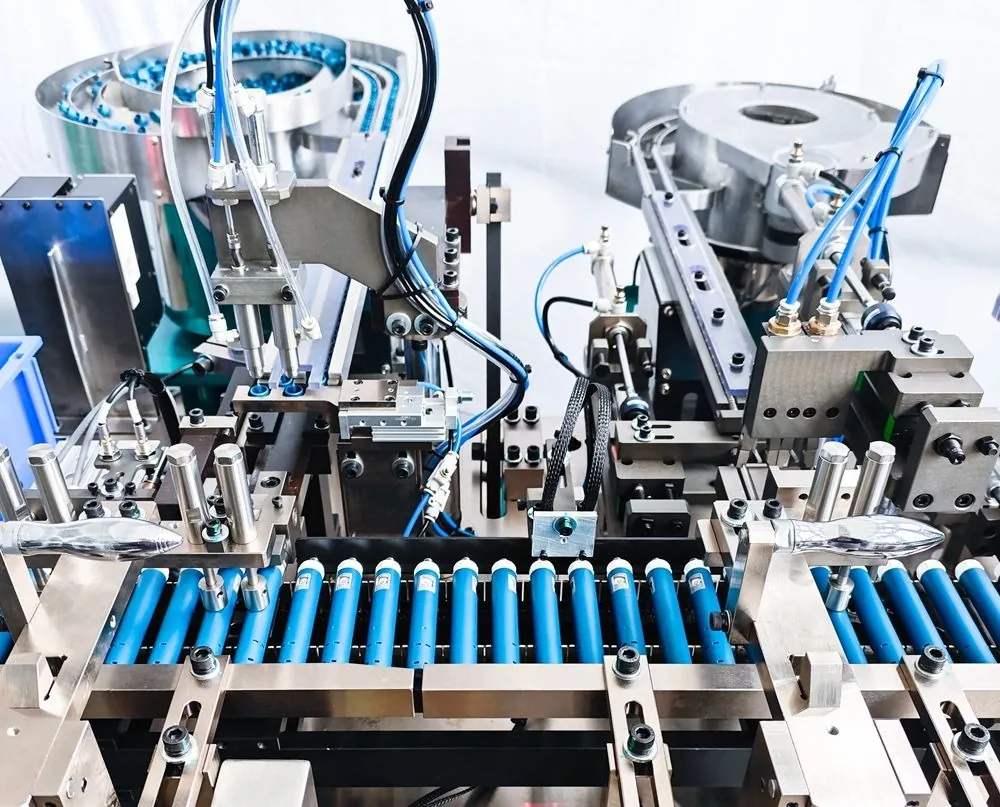
A row of test heads pressing on blue pens on the chain conveyor of the assembly and testing machine.
Step 2: a row of test heads presses on the pens on the chain.
Vibratory bowls with feed tracks above the chain conveyor of the assembly and testing machine, with a row of blue pens on the chain below.
Step 2: vibratory bowls feed the parts to the chain.
An assembled pen lying on a carrier on the chain: a torque head turns it one way and then the other, a length line runs along the pen, and the dose window with its zero mark is outlined.
Figure 2. The checks on an assembled pen: torque in both directions, length, and the dose window with its zero mark.

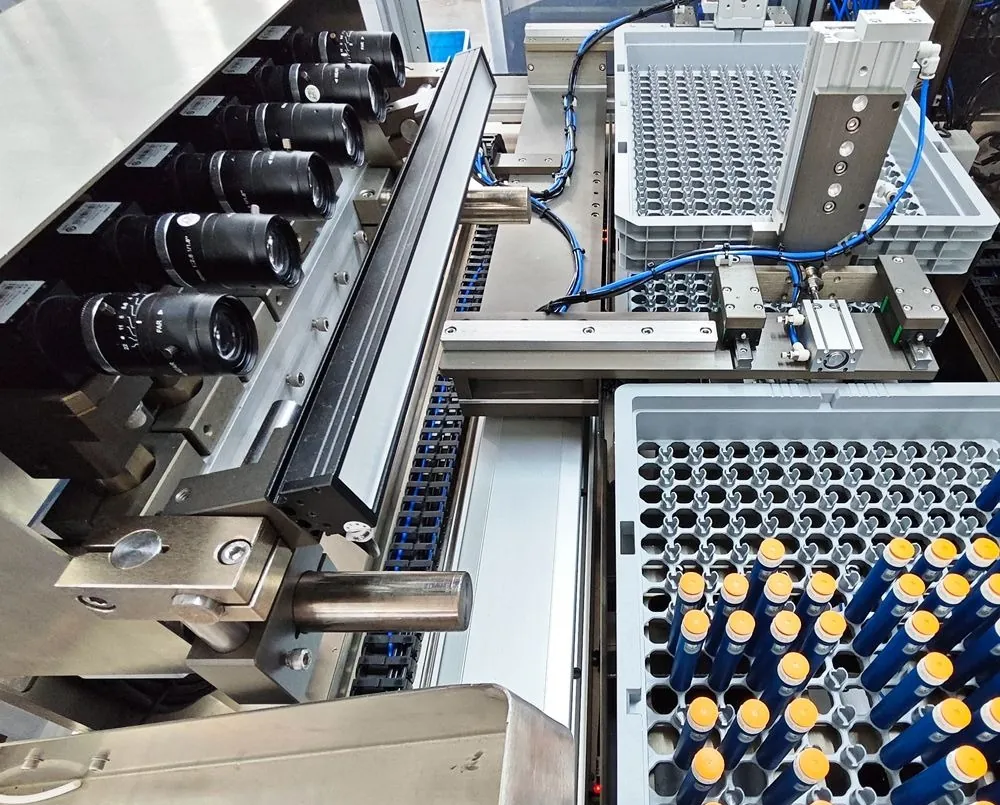
3. Inspect and load into trays. Cameras and sensors check each pen, and a four-axis robot loads the good pens into trays. The line checks the spring, the window, cracks and raised gate marks, and the zero mark in the window; faulty pens are sorted out. The standard model runs 60 pens per minute, two at a time, with empty trays fed in and full trays taken out. See the insulin pen inspection and tray loading line page for the standard model and video.

The insulin pen inspection and tray loading line. What you will see: a row of pens with orange caps under the camera station, then a four-axis robot lifting a row of pens and placing them in the tray.

A four-axis robot holding a row of pens above a half-filled tray on the inspection and tray loading line.
Step 3: a four-axis robot holds a row of pens above a half-filled tray.
A row of cameras on the inspection and tray loading line, with an empty tray at the top right and a tray filled with pens at the bottom right.
Step 3: cameras on the left, an empty tray and a full tray on the right.
An assembled pen under two cameras and a spring sensor: the spring, the window, a crack, a raised gate mark and the zero mark in the window are each marked.
Figure 3. What the cameras and sensors check: the spring, the window, cracks, raised gate marks and the zero mark in the window.

Which machine for your step

You needMachineStandard model
Putting the pen barrel togetherInsulin Pen Barrel Assembly Machine50–60 per minute, two at a time; 3100 × 1400 × 1800 mm
Assembling the pen and testing itInsulin Pen Assembly & Testing Machine50 per minute, two at a time; 5400 × 1600 × 1800 mm
Final inspection and loading into traysInsulin Pen Inspection & Tray Loading Line60 per minute, two at a time; laid out around your tray — send your tray size for a floor plan
Answers

Frequently Asked Questions

Insulin pen assembly is the process of putting an insulin pen together from its parts, testing it and loading the good pens into trays. Our machines cover three steps: the pen barrel, assembly and testing on one machine, and camera inspection with tray loading. We have supplied these machines to Bangladesh.
An insulin pen is assembled in three steps: (1) the barrel assembly machine screws and presses the barrels together and adds the spring and cap, (2) the assembly and testing machine assembles the pen and tests it, (3) the inspection and tray loading line checks each pen with cameras and loads the good ones into trays.
The insulin pen assembly and testing machine tests torque in both directions, length, the dose window and its zero mark on the same chain conveyor, and sorts out faulty pens. Tell us which checks your pen needs and we set the stations around them.
The standard models run on a chain conveyor, two pens at a time: 50–60 pieces per minute for the barrel assembly machine, 50 per minute for assembly and testing, and 60 per minute for inspection and tray loading. The speed depends on your pen and the checks it needs. Send us your pen parts and your target output.
Insulin pens are inspected by cameras and sensors on the inspection and tray loading line. They check each pen for the spring, the window, cracks, raised gate marks and the zero mark in the window; faulty pens are sorted out, and a four-axis robot loads the good pens into trays. The line is set up for your own pen, checks and tray.
Yes. The insulin pen assembly and testing machine assembles the pen and tests it on the same chain conveyor, checking torque in both directions, length, the dose window and its zero mark. The standard model runs 50 pens per minute, two at a time, with vibratory bowls feeding the parts.
The inspection and tray loading line is set up for your own tray. Send a photo or drawing of the tray with the pen, and we'll tell you whether it fits. The robot loads a row of good pens into the tray, with empty trays fed in and full trays taken out.
To quote an insulin pen machine we need drawings or photos of each part and of the assembled pen, what each part needs to be checked for, and your target output. Send them and you get an exact quote within 24–48 hours.
No. You can automate just one step, or all three. The three machines are separate: the barrel assembly machine, the assembly and testing machine, and the inspection and tray loading line. Tell us which step you want to automate, and we'll check your parts against that machine. For the full injection pen assembly line, see our pen injector assembly line.
They are rejected at the station that finds the fault. The barrel assembly machine checks after each step and rejects faulty pieces. The assembly and testing machine rejects pens that fail the torque, length, dose window or zero mark check. On the inspection line, cameras and sensors check each pen, and only good pens are loaded into trays.
On the barrel assembly machine, the pen barrels come from a hopper. On the assembly and testing machine, vibratory bowls feed the parts and a gripper head presses them into the pens on the chain. Send drawings or photos of each part, and we'll set up the feeding around your parts.
The standard machines are built for insulin pen injectors. For an auto-injector or another pen design, send drawings or photos of each part and the assembled device, and we'll tell you which of these steps apply. See pen injector and auto-injector assembly machines.
We do. We supply the machine, made to your parts by a long-term partner factory. We install and commission it on site, train your team and supply the spare and wear parts, so after-sales goes through one contact: Aman.

Planning a pen assembly line?

Send drawings or photos of your pen parts and your target output. Get an exact quote within 24–48 hours. Need all three steps? See the pen injector assembly line, or tell us which step you want to automate.

Get a Quote

Planning an Assembly Machine?

Send us your part drawing or photos. We check which machine can assemble it, then send you a quote.

Attach part drawings or photos (optional)

    By submitting this form you agree that we may use your details to reply to your inquiry, as described in our Privacy Policy.

    WhatsApp

    Prefer direct? Email sales10@amanmachinery.com · WhatsApp +1 773-386-2484