
How a Trigger Sprayer Is Assembled, Step by Step
How a trigger sprayer is put together by machine: from loose parts in a vibratory bowl to a finished sprayer with its dip tube, and the testing that follows, with real machines we supply.
What is a trigger sprayer? A trigger sprayer, also called a trigger spray gun or hand sprayer in the trade, is the pump head with a trigger that sits on a bottle of liquid such as a household cleaner. It is made of several moulded parts and a dip tube, and a machine puts them together. In one case we supplied, an all-plastic head made of three moulded parts is assembled at a rated 4,000 finished heads per hour.
Key takeaways
- Assembly runs in five steps: load the loose parts, feed and line them up, assemble station by station, fit the dip tube and discharge, then test.
- Vibratory bowls and feed tracks bring in the parts, and air-powered (pneumatic) stations join them; an inclined elevator can lift loose parts into the bowls.
- Output depends on the sprayer: a rated 4,000 heads per hour on the Pakistan machine for three-part all-plastic heads, and 40–50, 50–90 or 60–120 sprayers per minute on the other models.
- Testing can sit on the same machine as assembly, or on a separate tester running 50 or 100 sprayers per minute.
- Every machine is set up for your own sprayer parts, so speed follows your sprayer and its part count.
Video 1: the all-plastic trigger sprayer machine we supplied in Pakistan. What you will see: a vibratory bowl and feed tracks, the pneumatic stations on the assembly table, and a crate heaped with finished white sprayer heads.
The parts of a trigger sprayer
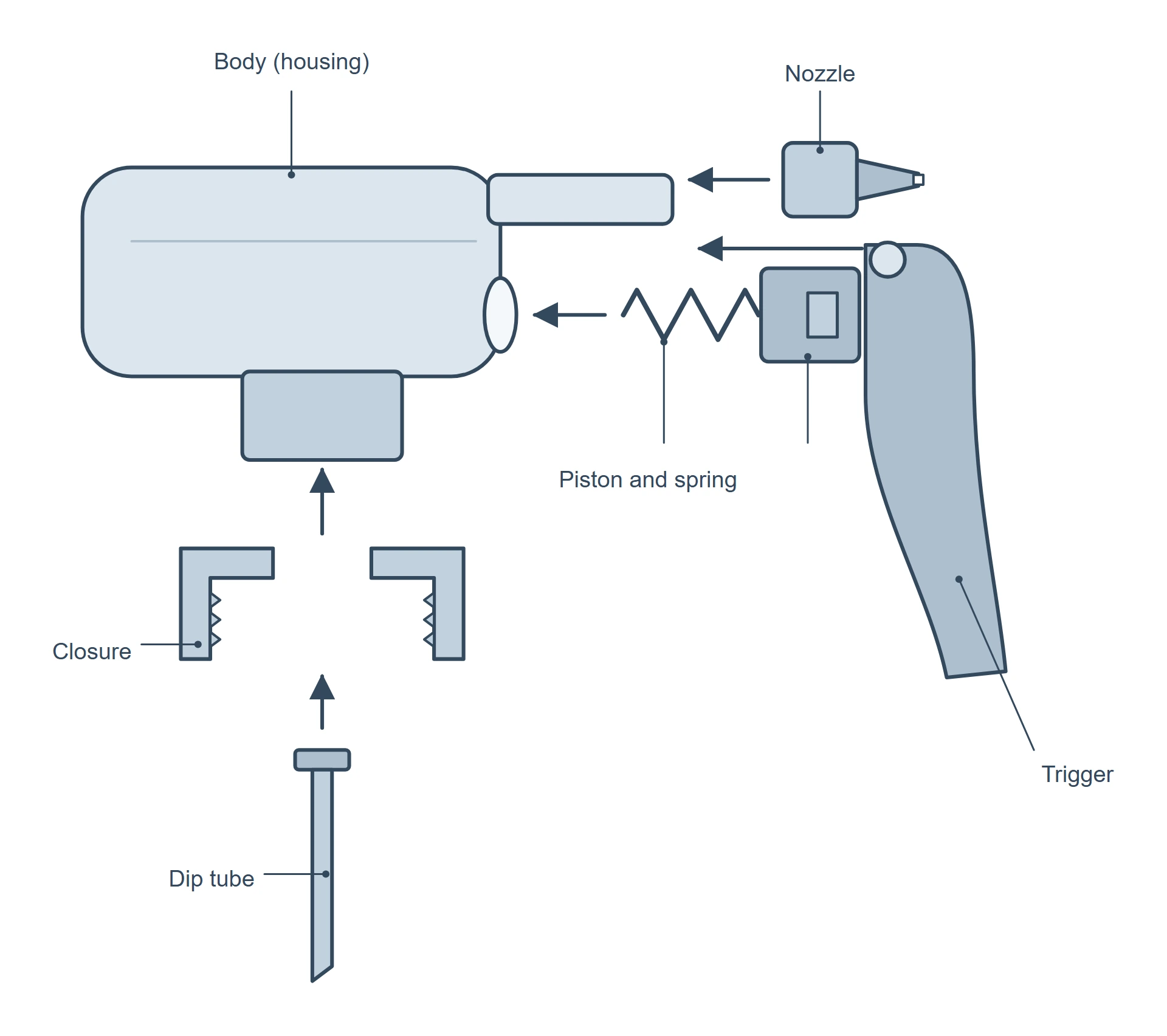
A trigger sprayer is built from a closure, a body (housing), a trigger, a nozzle, a piston with a return spring, two check valves and a dip tube, and the number of separate parts depends on the design. A continuous spray trigger sprayer has more parts than a standard one. In our Pakistan case the all-plastic head is assembled from three moulded parts, and a dip tube reaches down into the bottle. A fine mist sprayer is a small push-button pump sprayer rather than a trigger sprayer, and our bowl-fed machine assembles it too.
The five steps of trigger sprayer assembly
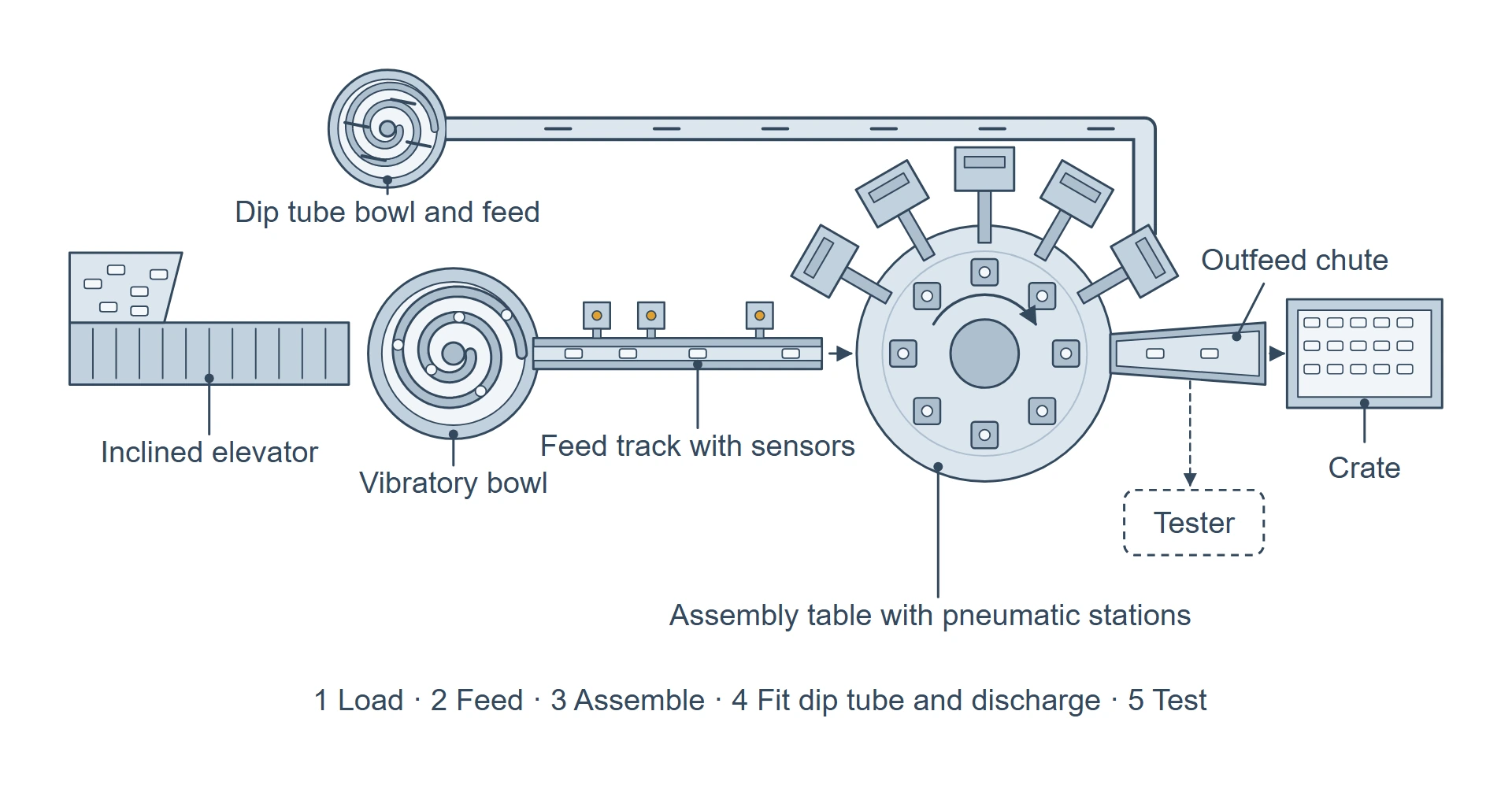
1. Load the loose parts. An inclined elevator lifts the parts and tips them into the vibratory bowls. On the machine we supplied in Pakistan, loose parts go into a tall inclined elevator, which lifts them and tips them into a vibratory bowl. The elevator is an option on the pneumatic trigger sprayer machine. See how a vibratory bowl feeder works.
2. Feed and line up. The bowls feed the parts along tracks, where they line up and move into the stations. In our video, clear and pink sprayer parts move through red-lit sensor stations on the machine. Each kind of part has its own bowl and track.
3. Assemble station by station. Pneumatic stations bring the parts together on the assembly table. On the continuous spray line, the sprayer heads stand in fixtures on rotary tables and move through the assembly stations, and a press station pushes each head down into place. On the bowl-fed fine mist machine, a rotary table carries each sprayer from station to station.
4. Fit the dip tube and discharge. Where the machine fits the dip tube, the finished sprayer leaves with it in place and drops into a box, a crate or a bin. On the pneumatic machine in Video 2, finished sprayers leave the rotary table with their dip tubes fitted and drop into a box. On the Pakistan machine, finished heads slide down stainless steel chutes into collection crates, and on the fine mist machine they drop into a collection bin.
5. Test. A tester checks the sprayer after assembly, on the same machine or on a separate one. The all-plastic trigger sprayer assembly and testing machine assembles and tests on one machine, so no separate tester is needed after assembly, and the assembly line with inspection ends with an inspection section. A separate tester takes sprayers that are already assembled. A trigger sprayer test can include a leak check and a spray check, for example whether it sprays and how much it delivers per stroke. Tell us what each sprayer needs to be checked for.
Which machine for which sprayer
| You need | Machine | Output |
|---|---|---|
| A three-part all-plastic head, stand-alone | Pneumatic Trigger Sprayer Assembly Machine | Rated 4,000 heads per hour on the Pakistan machine; typical 220 V, 1–1.2 kW, 0.6 MPa; speed set by your sprayer |
| Assembly and testing on one machine | All-Plastic Trigger Sprayer Assembly & Testing Machine | 50–90 per minute, depending on the station |
| A full line with an inspection section | Trigger Sprayer Assembly Line with Inspection | 50–90 per minute, depending on the station |
| A standard trigger sprayer (spray gun) | Trigger Sprayer Assembly Machine AM-TY-02 | 60–120 per minute (standard model) |
| A continuous spray trigger sprayer | Continuous Spray Trigger Sprayer Assembly Line | About 40–50 per minute (typical) |
| A fine mist sprayer, the small sprayer used on perfume and toner bottles | Bowl-Fed Fine Mist Sprayer Assembly Machine | 60–70 per minute (standard model, six-part sprayer with dip tube); single-phase 220 V, 0.4–0.6 MPa |
| Testing assembled sprayers | Trigger Sprayer Testing Machine; Sprayer Testing Machine | 50 per minute; 100 per minute (six-station tester) |
The machines at work
Video 2: a pneumatic trigger sprayer assembly machine. What you will see: finished trigger sprayers with dip tubes leave the rotary table and drop into a box.
Video 3: a trigger sprayer line with inspection. What you will see: a trigger sprayer line with a rotary table, vibratory bowls and a red-lit inspection track.
Video 4: a continuous spray trigger sprayer line. What you will see: sprayer heads move through the rotary stations while a press head pushes each one home.
Video 5: a trigger sprayer testing machine. What you will see: clear sprayer bodies sit on the testing station as the rotary table indexes.
Video 6: a sprayer testing machine. What you will see: a rotary testing table under blue light, with air cylinders working at each station.