
Flip-Top vs Disc Top vs Push-Pull Cap Assembly
How a flip-top, a disc top and a push-pull cap are each assembled or closed by machine, which machine each one needs, and what it looks like on the cap lines we have supplied.
What is the difference between flip-top, disc top and push-pull cap assembly? A flip-top cap leaves the mould with its lid standing open, so a closing machine snaps the lid shut. A disc top cap is a base and a disc, and a push-pull cap is usually two pieces too, so an assembly machine presses the pieces together into one finished cap. The first needs a closing machine, the other two need an assembly machine.
Key takeaways
- Flip-top caps are closed, not assembled: the closing machine handles up to 6,000 caps per hour, depending on the cap, and can stand beside the injection moulding machine.
- A flip-top cap made of several parts is the exception and goes on the multi-part machine AM-TY-04, which puts the parts together by machine instead of by hand.
- Disc top caps are pressed together from two pieces on a rotary table; the machines we supplied are rated at 4,800 per hour in the UAE, 4,000 in Pakistan and 2,000 in Bangladesh.
- A push-pull cap is usually two pieces pressed together; the Indonesia machine, for two-piece caps, is rated at 7,200 per hour.
- Beside a moulding machine, the mould sets the pace: an 8-cavity mould on a 20-second cycle gives about 1,440 caps per hour.
Video 1: a disc top cap assembly machine we supplied in the UAE. What you will see: a vibratory bowl heaped with green caps, the rotary table where each cap stands upright in its own round black holder, and finished caps sliding down a stainless steel chute into a carton.
Three caps, two kinds of machine
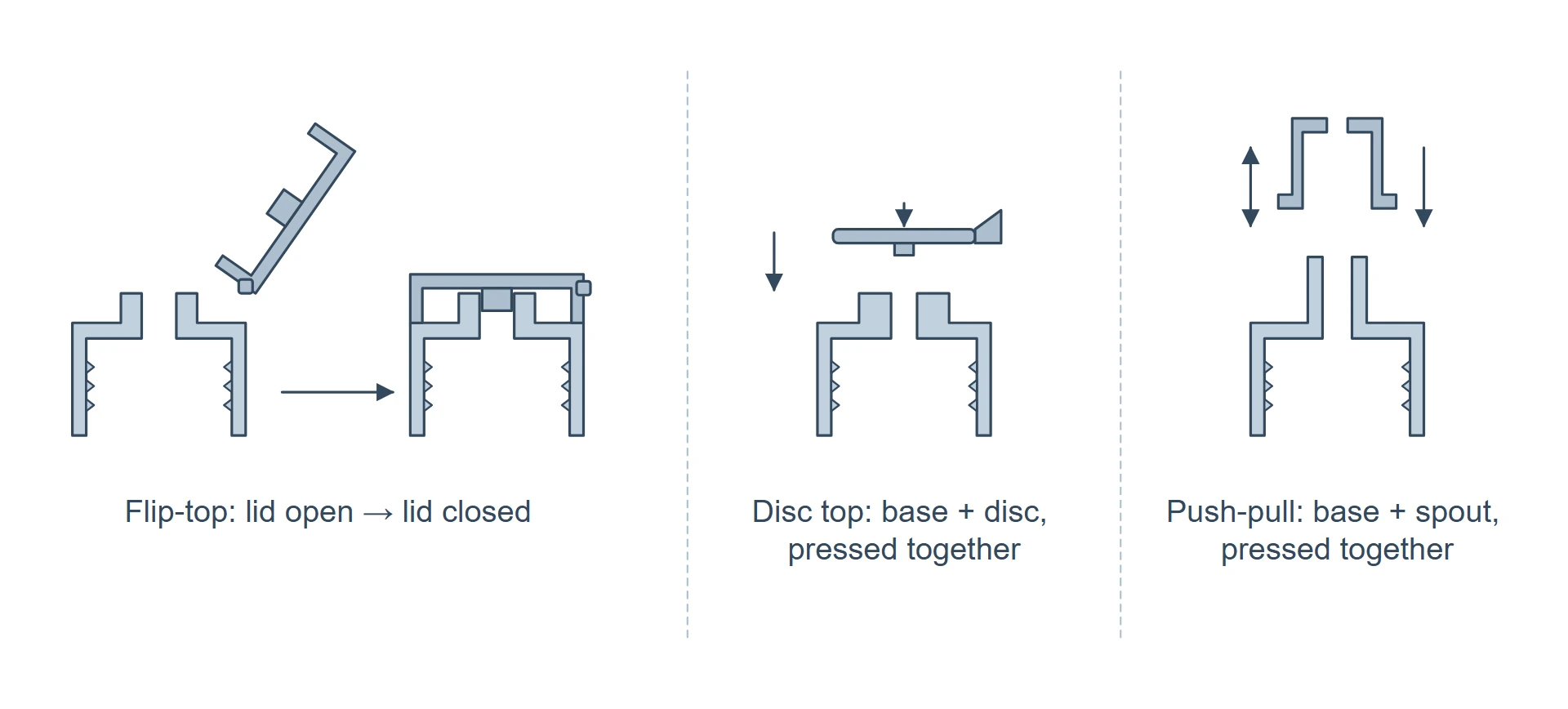
The caps differ in how they leave moulding, and that sets the machine. A flip-top cap comes out complete, with the lid standing open. Disc top caps, and most push-pull caps, are made of two pieces, which have to be joined. A cap machine assembles or closes the cap itself; it does not screw caps onto bottles, and the finished caps go to your filling and capping line. A disc top cap is a base and a disc: pressing one side of the disc opens the dispensing hole. A push-pull cap is a base and a spout that is pulled up to open and pushed down to close; most are two pieces, and some designs add a third.
Flip-top: the lid has to be closed
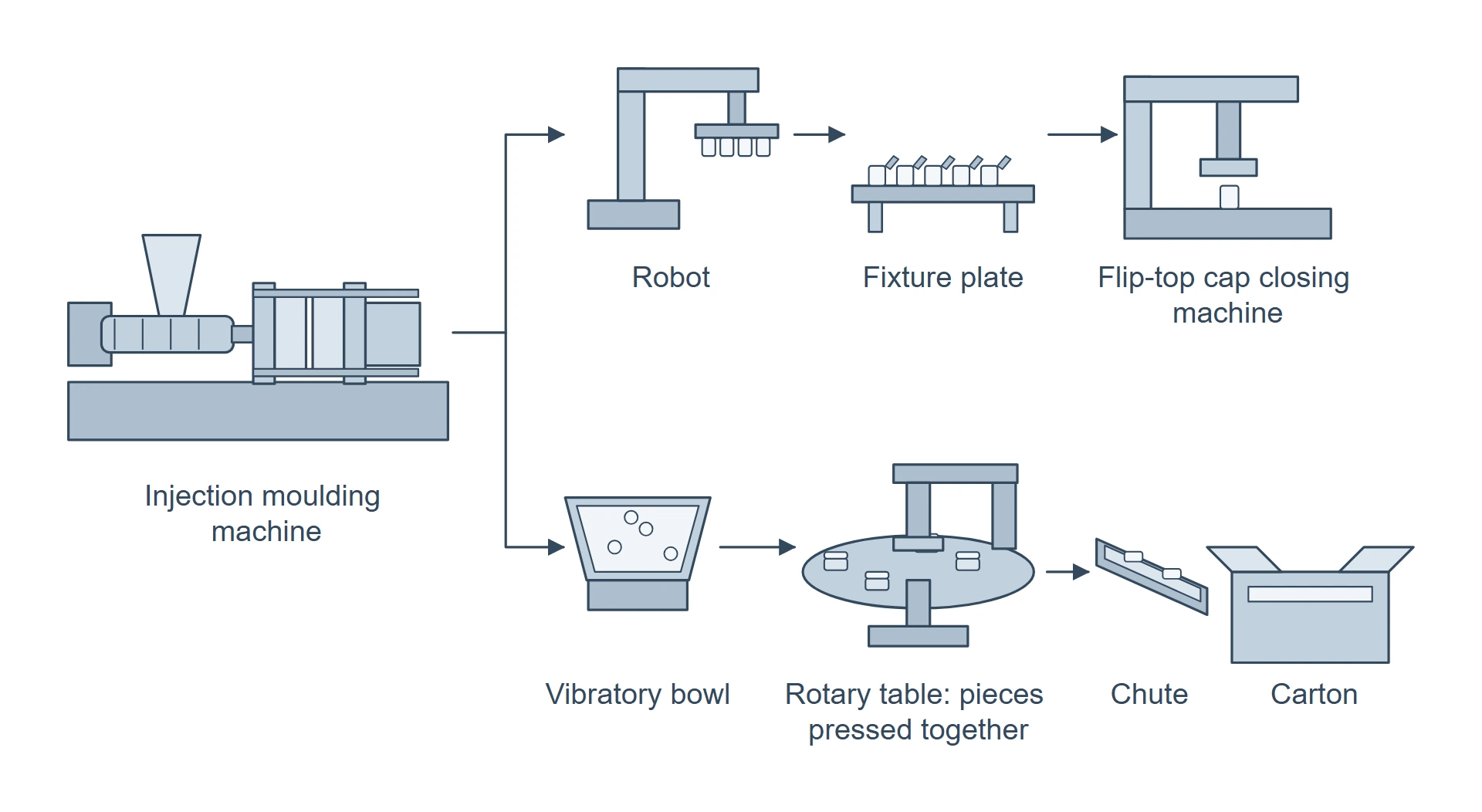
Flip-top caps leave the mould with the lid standing open, and each lid has to be shut before the cap goes on a bottle. The flip-top cap closing machine snaps the lids shut, at up to 6,000 caps per hour, depending on the cap. On a shampoo cap line we supplied in Pakistan, it stands right beside an injection moulding machine: the moulding machine's robot sets each shot of 8 caps onto a fixture plate, and the closing machine shuts all 8 lids in one go. Its speed is set by the customer's 8-cavity mould on a 20-second cycle, about 1,440 caps per hour. For a flip-top cap made of more than one part, the multi-part flip-top cap assembly machine AM-TY-04 puts the parts together; its speed is confirmed for your cap before you order.
Disc top: two pieces pressed together
A disc top cap is assembled from two pieces: the machine presses them together into one cap. On the machine we supplied in the UAE, a vibratory bowl feeds the green cap parts, flat green discs travel to the table on twin lanes, each cap stands upright in its own round black holder on the rotary table, and the two pieces are pressed together as the table indexes round from station to station. Finished caps slide down a stainless steel chute straight into cartons. Rated output is 4,800 caps per hour. The Pakistan machine for blue disc top caps is set up differently, with the parts coming down an inclined track on their sides and each cap held in a square fixture plate, and is rated at 4,000 caps per hour. We have also supplied disc top cap machines to Bangladesh, rated at 2,000 caps per hour.
Push-pull: two pieces pressed together
A two-piece push-pull cap is assembled by pressing its two pieces together on a rotary index plate. For a customer in Indonesia we supplied a machine for two-piece plastic push-pull caps, rated at 7,200 finished caps per hour. Two vibratory bowls sort the black cap parts and send them along feed tracks, past a row of red-lit sensors, to the index plate where the pieces are pressed together. Finished caps slide down a stainless steel chute into a blue crate.
Match the machine to the mould
When the cap machine runs with a moulding machine, the mould sets the speed. The two-piece cap assembly machine can be set up in line with the injection moulding machine, so parts go straight to assembly without manual handling. A rotary star-wheel machine we supplied to Ghana for two-part food caps is matched to a 10-cavity mould and runs about 1,200 caps per hour. The cavity count and cycle time of your mould decide the speed, so send both with your cap drawing.
Which machine for which cap
| Cap | What comes out of moulding | Machine | Case | Rated or typical speed |
|---|---|---|---|---|
| Flip-top | A cap with the lid open | Flip-Top Cap Closing Machine | Pakistan (shampoo caps) | Up to 6,000 per hour, depending on the cap; about 1,440 per hour on an 8-cavity mould with a 20-second cycle |
| Flip-top made of more than one part | Separate parts | Multi-Part Flip-Top Cap Assembly Machine AM-TY-04 | – | Confirmed for your cap before you order |
| Disc top | Two pieces | Rotary assembly machine (Bottle Cap & Closure Assembly Machine) | UAE; Pakistan; Bangladesh | 4,800 per hour (UAE, rated); 4,000 (Pakistan, rated); 2,000 (Bangladesh, rated); standard model 30–40 per minute |
| Push-pull | Usually two pieces | Rotary assembly machine | Indonesia | 7,200 per hour (rated) |
| Two-part food cap | Two parts | Rotary star-wheel machine | Ghana | About 1,200 per hour with a 10-cavity mould |
The machines at work
Video 2: a flip-top cap closing machine we supplied in Pakistan. What you will see: the machine beside the injection moulding machine, shutting each shot of 8 shampoo caps in one go.
Video 3: a push-pull cap assembly machine we supplied in Indonesia. What you will see: two vibratory bowls and a sensor-lined track, the index plate where the two pieces are pressed together, and finished black caps heaped in a blue crate.
Video 4: a multi-part flip-top cap assembly machine. What you will see: a vibratory bowl feeds black flip-top caps along the track to the rotary table.